In western countries, sake is the name given to Japanese rice wine, although it is actually more a type of beer than wine. To make sake, rice is mixed with water and yeast to form a paste and left to ferment for a few weeks.

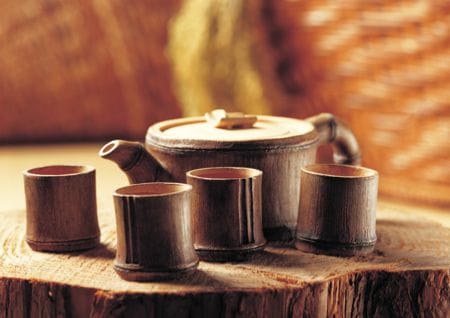
Sake is usually served in a ceramic vessel called a tokkuri, which has a domed belly and a narrow neck. There are different types of traditional cups into which the sake is poured: a saucer-like ceramic or porcelain cup (okocho/sakazuki) or a wooden teacup (masu). Modern Japanese allow us Europeans to drink sake from wine glasses, as the full bouquet of the drink can be enjoyed from these.
Depending on the quality of the sake, the serving temperature varies. Honjozo-shu, for example, is drunk at room temperature. Other types of sake, such as ginjo-shu and namazake, are usually served chilled. Lesser quality sake is warmed before serving to allow excess alcohol to escape.
First, sake is poured into the guests' cups. Guests are responsible for ensuring that the host's cup is not empty, so never serve yourself. Sake is poured with one hand, unless the person serving is higher than the guest. In this case, the pouring hand is supported lightly with the other.
The cup is held with both hands when drinking. If the cup is held in the hand while pouring, one hand is held under the cup and the other is used to hold it loosely from the side.
For the toast, the cups touch lightly and one calls out "Kanpai". The rim of the cup of the lower-ranking person must be lower than that of the higher-ranking person.
The sake is to be enjoyed and is not to be emptied in one go. The cup is sipped only lightly, with the lower-ranking person turning their head a little to the side. The drinking of sake is meant as a social gathering, people should primarily sit together and talk while enjoying the sake.