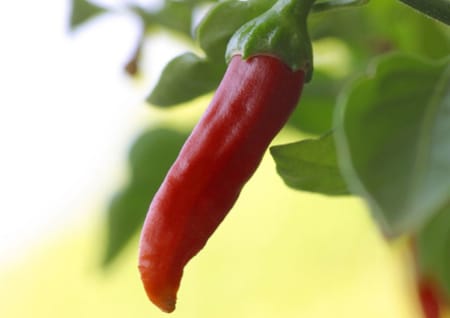
The burning sensation in the mouth when eating hot chilli peppers or hot peppers is caused by a naturally occurring substance, capsaicin. Capsaicin is found in large quantities in the inner flesh of the chilli pepper and in small amounts in the skin. The seeds do not contain capsaicin.

Spicy food. what causes the burning sensation?
Capsaicin is a natural defence mechanism against animals. When eaten, it irritates the mucous membranes in the mouth and causes a burning sensation of varying intensity, depending on the capsaicin content of the pepper. The capsicum is the only member of the Capsicum family that contains little or no capsaicin and therefore has a mild and sweet flavour.
The world's hottest chilli variety is the Bhut Jolokia, originally from India. The seeds of chilli peppers are mainly spread by birds, which do not have the same receptors as mammals to which capsaicin binds. This is why birds do not experience any irritation of the mucous membranes when pecking the seeds out of the fruit flesh.
Capsaicin is not only a hot spice, but also has anti-fungal and antimicrobial properties. Other medicinal properties of the substance are also being researched. For example, there are indications that capsaicin has a preventive effect against diabetes. There are also strong suspicions that capsaicin is capable of destroying prostate cancer cells. Experiments have shown that cancer tumours treated with capsaicin were around 20% the size of untreated tumours.
The burning sensation in the mouth caused by capsaicin gradually disappears on its own after 6 hours at the latest. The most effective way to relieve the burning sensation is cold milk, as the casein contained in milk has a neutralising effect on the capsaicin. A cold sugar solution has also been shown to be effective against the burning sensation. The solution should consist of 10% sugar and 90% water and is most effective at room temperature (approx. 20 degrees).
Pure water is only effective against the burning sensation as long as the water is in the mouth, but otherwise has no soothing effect on the oily capsaicin. The burning pain triggers the release of endorphins in the brain and can therefore lead to euphoric sensations. The chemical processes in the body also make capsaicin useful as a local analgesic.
At the beginning of the 20th century, Wilbur Scoville experimented with capsaicin and developed a scale to indicate the pungency of the substance (Scoville scale). Pure capsaicin measures 15 to 16 million units. The world's hottest chilli mentioned above measures 1 million units on the Scoville scale. Quantities of around 2500 to 10000 units are used in cooking. Tabasco pepper measures around 30,000 units.
Depending on the type of pepper, the seasoning must be used sparingly when cooking, as the spiciness spreads throughout the dish and overpowers other flavours.
The essential oils of capsaicin not only sting the mouth, but can also irritate the mucous membranes of the nose and eyes if they come into contact with them through the hands. To be on the safe side, wear rubber gloves when cutting the chilli pepper or wash your hands immediately.