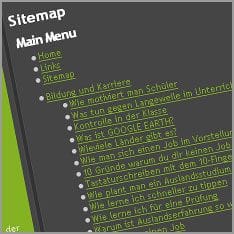
A sitemap is often seen as superfluous when designing a website, which is certainly the case if you only include the sitemap in the page in order to have a sitemap. If you understand the purpose of a sitemap properly, you can tailor it to your specific requirements.
What can you use the sitemap for?
Navigation

A sitemap works like a map of your website. If a surfer is looking for something on your website, they can easily get lost between dozens or even hundreds of pages. Then they can simply go back to the sitemap and find what they are looking for with ease.
Transmission of the topic of the page
When visitors to your website look at the sitemap, they will recognise the main topics at a glance. This can save the reader endless reading through your pages.
Optimisation of the website
With the sitemap, you create a single page that contains links to each of your pages within the website. So when the search engine comes across your website, the programme robot can follow the links from your sitemap and add each of your pages to its directory. For this reason, the link that leads to your sitemap should also be easy to find on the homepage.
Order and relevance
A sitemap allows the visitor to recognise the structure of the website at a glance. Every time you want to add new content in the future, you can use your own sitemap to help you. This gives you a perfectly organised website where all topics are sorted according to their relevance.
A sitemap is extremely important for larger websites, as it allows you to maintain an overview and makes it clear for visitors.