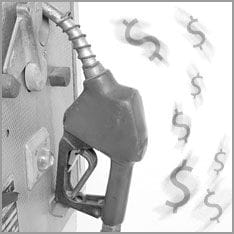
Refuelling in Germany has become a lottery. The prices for normal petrol and diesel go up and down, sometimes changing twice a day.

The drivers of this nation, which loves its cars so much, are forced to accept rising petrol prices.
What do Germans think about the high petrol prices?
Record prices on the international oil market have driven up prices throughout Europe. A litre of regular petrol currently costs an average of €1.43 per litre.
The high petrol prices are hitting people where it hurts, in their wallets.
Many people are dependent on their vehicle. They work at least 20 kilometres from their home and have no way of getting to work by public transport.
At the petrol station, you can see people filling up with a precisely calculated minimum amount of petrol or diesel in the hope of a price reduction.
The bus often doesn't save any money either, with many people complaining that tickets are too expensive in their region. They therefore prefer to continue taking the car and make sure they don't spill a drop when refuelling.
At the weekends, vehicles with large tanks make a pilgrimage to neighbouring countries because petrol is much cheaper there and the long journey is worthwhile if you fill up with enough fuel.
Friends and families have formed a network and inform each other when they spot a cheaper petrol station.
You can search for the cheapest petrol station in your area on websites such as www.clever-tanken.de.
Despite the high petrol prices, Germans remain loyal to their motorways. Petrol stations report that sales continue to be good and are even increasing every year. Even though everyone is complaining about the high petrol prices, most people are not cutting back on driving. They save money elsewhere so that they can afford the petrol. Germans love their cars too much for that.
In fact, registrations for new vehicles have risen by 25% compared to the previous year. Car manufacturers are experiencing an upswing with Europe's largest vehicle manufacturer Volkswagen leading the way with sales of more than 89,000 new vehicles in the first two months of 2008. Last year, a total of 3.5 million new cars were sold in Germany.
Car manufacturers BMW and Mercedes-Benz, known for heavy and elegant cars with relatively high fuel consumption, are supporting the trend towards fuel-efficient models with alternative technologies. At the recent Geneva International Motor Show, 17 out of 94 vehicle models were equipped with engines that run on alternative fuels.
According to Volkswagen's announcement, the new Golf generation will also be available with a hybrid engine by 2009.
The question remains whether Germans will pay more for more environmentally friendly cars?
According to a survey of consumers, most Germans are not prepared to pay more for environmentally friendly technologies in their vehicles as long as there are no tax reductions to make a low-emission vehicle more attractive.
The survey also showed that European drivers have hardly changed their driving behaviour despite climate change. But after all, work is always being done on the further development of low-emission vehicles and a 'clean future'.
However, the number of gas-powered vehicles in Europe has increased significantly in the last few years. In Germany alone, there are now 200,000 of these environmentally friendly vehicles on the roads and more than 3,500 gas filling stations have been upgraded with gas pumps.
For some years now, there have also been courses where you can learn how to save petrol while driving. The rule of thumb is to change gears early, keep the car running at lower revs and switch off the engine when stopped for long periods at level crossings or traffic lights.