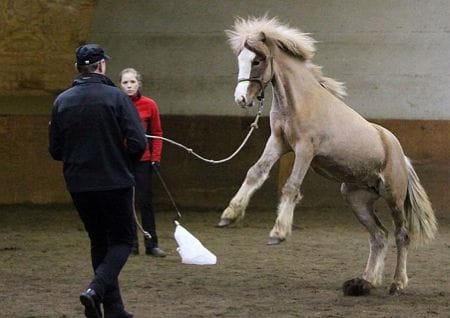
Horses are very strong animals, much stronger than humans. You should therefore never use force to teach a horse to mount on command, because a horse in panic or anger can fall over backwards when mounting and injure itself and the rider. Only an experienced rider should teach their horse to mount.

Teaching a horse commands requires patience and understanding for the animal. Don't expect too much progress in one day and praise the horse for small steps in the right direction. The training area should be large enough, with few or no other horses and riders in the vicinity and no objects in the way. It goes without saying that there must be enough space at the top when the horse starts to mount. Some horses are easily distracted from their work, so there should be as little noise and movement around the horse as possible.
Training is best started from the saddle. Firstly, horse and rider need to warm up together and form a harmony before the horse is ready to learn something. It is also better if the horse has expended some energy and calmed down first, especially with an exercise such as mounting. The rider brings the horse to a halt, waits until it is completely calm and relaxed and leans slightly backwards in the saddle. Press lightly but firmly into the horse's flanks with the thighs and at the same time pull briefly on the reins a few times, but without pulling in the mouth. The horse already knows these commands as going forwards (leg pressure) and stopping (rein pull). When seemingly contradictory commands are used at the same time, most horses react intuitively by lifting their body weight from the front legs and shifting it to the hind legs. The command is given during the leg aids and rein pressure. The command word should be short and consistently used in conjunction with the same exercise so that the horse develops an association bridge.
Praise the horse's neck with every correct approach so that it understands what is expected of it.
Once the horse has understood the exercise, the training can be extended by the rider directing the mount from the ground. Of course, it is important to remember that a rising horse will be much bigger, so it is less frightening and also less dangerous if the rider stands slightly higher. Stand in front of the horse with a few horse treats in your pocket. Raise an arm with a treat and at the same time say the command word in a certain voice. The horse will now probably stretch its neck to get the reward. If the arm is high enough, the horse must lift its front feet off the ground to reach it. Together with the previously formed association with the command word, a horse now understands relatively quickly what it is supposed to do. The rider should reward each lifting of the front feet with a treat so that the horse learns to mount completely soon.
It is important to repeat the exercises consistently and regularly and to praise the horse for its progress. The more the horse is trained, the more natural it will become to mount on command.