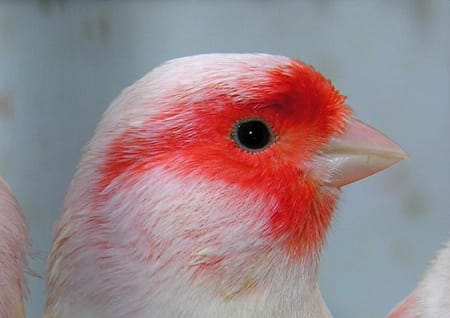
Unlike a budgerigar, a canary is not a sociable bird by nature. This is not due to their character, but to their genetic disposition.

A bird that lives in larger flocks in the wild also seeks to socialise with conspecifics in captivity. Wild canaries have strictly demarcated territories during the breeding season, which a pair of birds defends against conspecifics. The fact that the birds form flocks after the breeding season in autumn and winter is a protective measure and not a social urge. They are protected against predators in large flocks, but do not know each other.
Not every canary looks for a mate during the breeding season. They often stay alone for a year.
The fact that the canary is a solitary bird also means that it does not form a personal bond with a human. Although it recognises when the same person gives it food and water, it does not develop close contact with a human. Only a hand-reared canary has a deeper bond with the person who raised it. As it has not got to know its own parents, it regards the human as its conspecific.
A canary is therefore an ideal pet for people who are very busy and don't have time to bond with their pet. The canary is usually very happy if it has enough food and water, can clean itself and has a sufficiently large cage.
Nevertheless, even a canary needs some variety in its life to stimulate its senses. It should be allowed to fly freely around the room from time to time.
Although the canary is a solitary bird, it is still better to keep them in pairs so that they don't get bored in the long term. It doesn't matter whether males and females live together mixed or separately, as the canary will not breed as long as there is no nest.