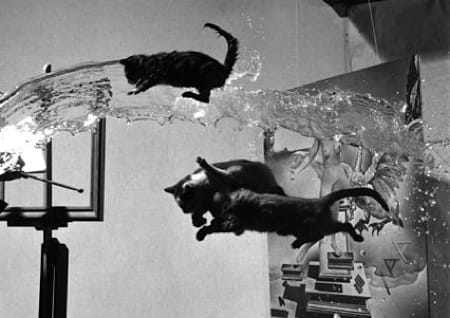
Cats have a keen sense of balance that allows them to balance along wafer-thin, metre-high fences. If the cat does lose its balance, it almost always lands on its feet, even if it falls sideways or backwards.

The cat owes its ability to perform tightrope-walking tricks to the fine coordination of its body and nervous system. Their flexible physique gives them maximum freedom of movement; the tail acts as a counterweight and equalises the balance.
The cat has an organ of balance, the vestibular apparatus, which is located inside the ear. The vestibular apparatus consists of three fluid-filled channels that are covered with countless fine hairs. When the cat's head moves, the fluids shift, which in turn influence the position of the hairs. A signal is then sent to the brain, which provides precise information about direction and speed. This information is processed together with that of the eyes and muscles.
The organ of balance is found in almost all mammals, but in no animal species is it as finely developed as in cats. One of the cat's unique abilities is that it is always able to land almost on its feet after a fall. During the fall, a series of automatic events take place in the cat's nervous system and brain, enabling it to turn 180 degrees in less than a tenth of a second.
Despite this amazing ability, a cat is not invulnerable to very deep falls. Also, cats are born with the organ of balance, but not with the developed coordination of body and brain. The sense of balance begins to develop at the age of two weeks, which is why kittens must learn to jump from this age in order to perfect their balance and coordination.